General
A4 Envelope Die-Cut: Illustrative Layout and Size Marks
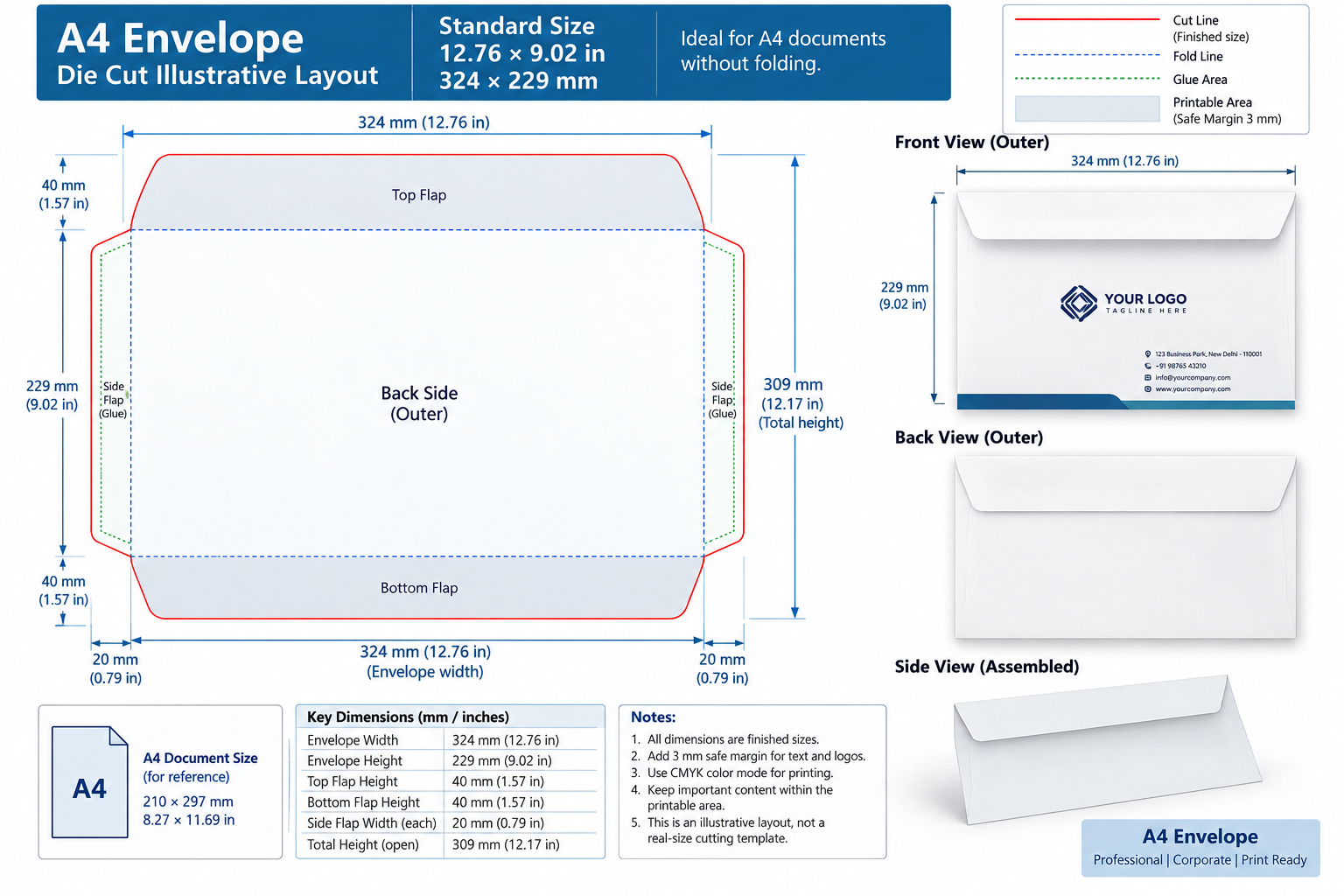
An A4 envelope die cut is a cutting template used to produce an envelope suitable for holding A4 documents. A well-prepared layout includes the envelope panels, folding lines, glue flaps, bleed, and accurate size marks to ensure a smooth production process.
The standard finished envelope size is generally designed to accommodate an A4 sheet measuring 210 × 297 mm. Depending on the required fit, the envelope may use a finished size of approximately 229 × 324 mm. The die-cut layout usually contains a central document panel, side flaps, a bottom flap, and a top closing flap. These flaps are folded inward along clearly marked crease lines.
The illustrative layout should distinguish between cutting and folding instructions. A solid line commonly represents the cutting path, while a dashed line indicates a crease or fold. Glue areas should be marked clearly, especially on the side and bottom flaps. A minimum bleed of 3 mm is recommended for printed artwork extending to the edge.
All size marks must be placed outside the die-cut path to avoid confusion during production. Important dimensions include the overall flat layout, finished envelope size, flap widths, fold positions, glue areas, corner radius, and bleed allowance. Registration marks and artwork notes may also be added when required by the printer.
Before final delivery, the die-cut file should be checked for accurate scale, closed vector paths, correct bleed, and appropriate file format. A test print or paper mock-up is highly recommended to confirm document fitting, folding accuracy, and adhesive placement before mass production.